
Rethinking “One Wallet Fits All”: Rabby’s Security-First Play for DeFi Power Users
Misconception: a browser wallet is just a convenience layer — click approve and move on. That casual view is why many DeFi losses trace back to blind signing, accidental approvals, and network mistakes, not necessarily exotic zero-day exploits. Rabby positions itself as a corrective: a browser and desktop/mobile wallet that treats every interaction as a potential risk to be modeled before you consent. For experienced DeFi users who trade across L2s, route complex approvals, or manage institutional accounts, the difference between a wallet that surfaces noise and one that simulates consequences can be material.
This commentary walks through how Rabby’s mechanisms work, what concrete protections they offer, where they fall short, and how to fold them into operational discipline. I assume the reader trades, provides liquidity, or composes transactions that touch multiple EVM-compatible chains from the US regulatory and UX context; practical decisions will hinge on custody boundaries, hardware integration, and risk appetite.
How Rabby’s Defensive Stack Actually Operates
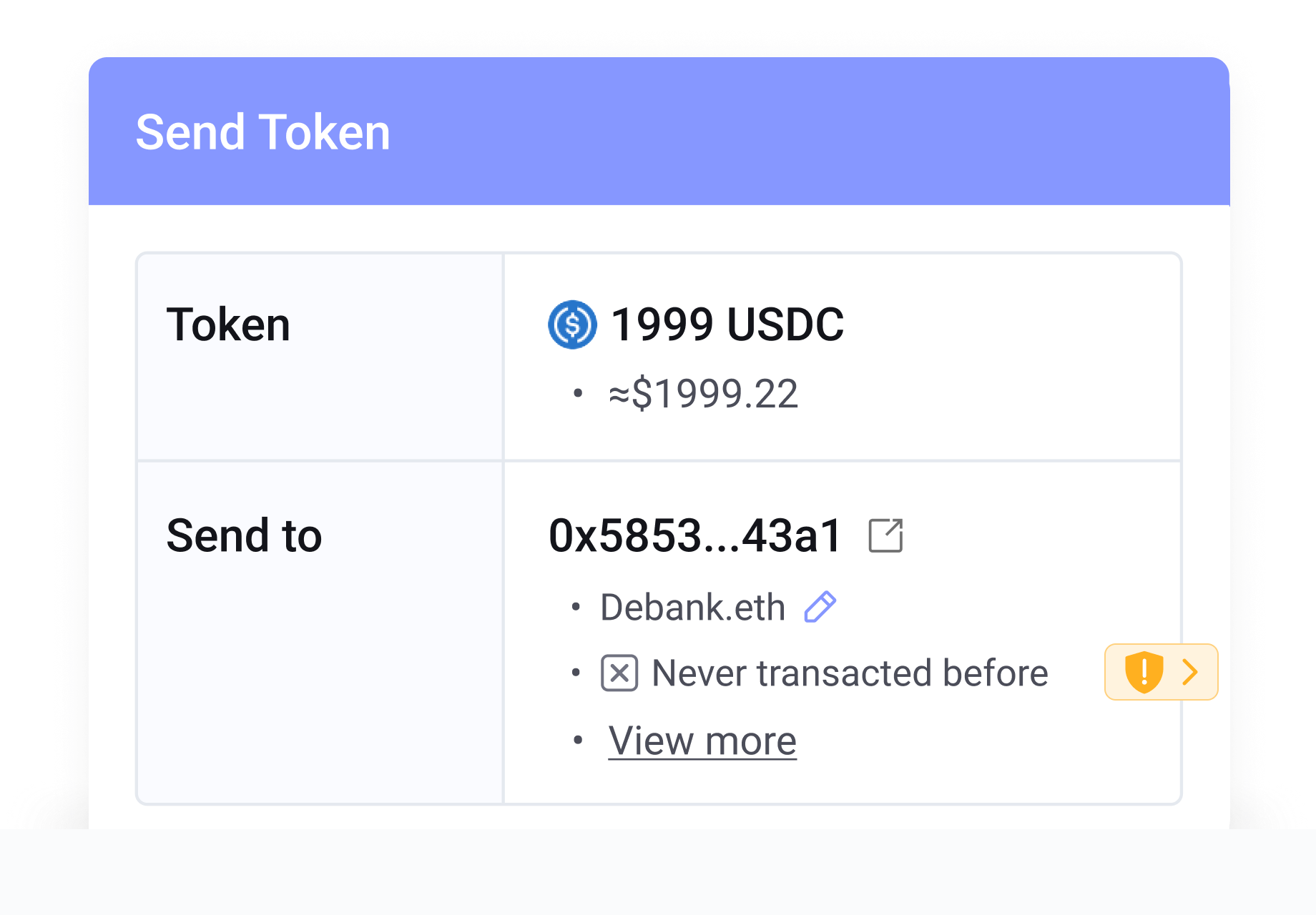
Rabby’s design rests on three mechanism-level pillars: simulation, pre-transaction risk scanning, and active remediation tools. Transaction simulation recreates the call flow a signed transaction will execute and produces estimated token balance changes and fee costs. That’s different from a simple human-readable summary: it’s a deterministic dry-run against the EVM state you’re connected to, which reveals the net token deltas you should expect. In practice this converts abstract calldata and method selectors into concrete accounting outcomes — a powerful anti-blind-signing control.
On top of simulation sits a security engine that scans the destination contract and calldata for signals such as prior exploit history, suspicious approval patterns (e.g., unlimited approvals or transfers to proxy addresses), and non-existent recipient addresses. When those signals cross thresholds, Rabby surfaces alerts and often blocks commonplace traps. Finally, it pairs those passive checks with active fixes: an embedded approval revocation UI and compatibility with hardware and multi-signature stacks (Ledger, Trezor, Gnosis Safe, Fireblocks, etc.). These reduce exposure windows after approvals are granted and let institutional users keep keys under stricter custody controls.
Why These Mechanisms Matter — And Where They Don’t
For power users the practical value is twofold. First, simulation reduces cognitive load: instead of interpreting low-level calldata yourself or trusting a pop-up text, you get an approximate accounting result. That matters when routing transactions across bridges or DeFi aggregators where slippage, token wrapping, or fee on transfer tokens produce surprising outcomes. Second, on-device scanning helps intercept social-engineering and known-bad contract interactions before signature.
Limitations are equally important. Simulation relies on current node state and the same onchain data you and an attacker share; it cannot predict the actions of other actors between simulation and inclusion (front-running, MEV sandwiching) or off-chain backend behavior of a given dApp. Relatedly, Rabby does not remove the need for good operational practice: hardware wallets remain the stronger defense for key compromise, and multi-sig custody is still the right default for institutional treasuries. Rabby’s features reduce, but do not eliminate, the attack surface.
Comparisons and Trade-offs: Rabby vs MetaMask and Others
Rabby sits in the crowded EVM wallet field alongside MetaMask, Trust Wallet, and Coinbase Wallet. The core differentiator is that Rabby treats signing as an analytical decision, not a confirmation ritual: automatic network switching and transaction simulation make cross-chain UX smoother and safer. MetaMask offers broad adoption and deep ecosystem integration, but historically leaves more of the interpretation burden to the user or external tools. Trust and Coinbase prioritize onboarding and fiat rails, which Rabby currently lacks: there is no built-in fiat on-ramp or native staking flow in Rabby today. That’s a deliberate trade-off: Rabby focuses squarely on transaction security and multi-chain visibility rather than brokerage-style UX.
For institutional users, Rabby’s integrations with Gnosis Safe and enterprise custodians like Fireblocks and Amber are crucial. They permit Rabby to act as a front-end signing and simulation layer while the keys remain in institutional vaults or multi-sig configurations, preserving both auditability and enforcement of policy controls.
Operational Heuristics: How to Use Rabby Well
Translate the features into habits. Here are re-usable heuristics for a US-based DeFi power user:
- Always combine Rabby’s simulation with hardware signing for large-value or high-frequency accounts. The simulation informs you what you’re about to sign; the hardware wallet prevents remote key theft.
- Use Rabby’s approval revocation immediately after interacting with new AMMs or bridges. Limit allowance lifetime and cap amounts where possible.
- Route institutional flows through a multi-sig (Gnosis Safe) and use Rabby as the UX/alert layer rather than as the sole custody point.
- Treat cross-chain gas top-ups as operational transactions — they lower friction but create new transfer surfaces that should be accounted for in treasury policies.
These heuristics reflect trade-offs: convenience versus compartmentalization, simulation visibility versus real-time adversarial dynamics like MEV, and software guards versus hardware custody.
Known Incidents, Open Questions, and What to Watch Next
No wallet is immune to mistakes. Rabby’s 2022 incident with an exploited swap contract (≈$190k loss) illustrates a structural truth: protocol code and ancillary services (like swap contracts) are attack surfaces distinct from the wallet itself. The team’s response — freezing the contract, compensating users, and increasing audits — is pragmatic but not a substitute for systemic defenses like minimized approvals, auditing toolchains, and compartmentalized trust boundaries.
Open questions that should matter to power users and security teams: how will Rabby scale its detection signals as attackers craft more subtle approval patterns? Can simulation expand to model cross-tx behaviors or MEV exposure in a usable way? Finally, the absence of fiat on-ramps and native staking means Rabby remains positioned as a power-user tool, not a consumer gateway. That focus is coherent, but it also frames what Rabby will or won’t solve for different user classes.
For a practical next step, explore the wallet’s repository and documentation to validate the open-source claims, test the transaction simulator on low-value trades, and run hardware wallet integrations under your normal workflows. For quick orientation, see official installation and feature notes at rabby.
Decision-Useful Takeaways
Rabby is best understood as a risk-management UX built into a non-custodial wallet: it reduces information asymmetry at signing and automates mundane network switching across 90+ EVM chains. Its real utility comes when used as part of layered defenses — hardware wallets, multi-sig, policy-led treasury operations — rather than as a single silver bullet. If you’re managing significant DeFi exposure from the US, treat Rabby as a valuable instrument in a toolbox whose other essential items remain multi-sig, hardware devices, and vigilant allowance hygiene.
FAQ
Does Rabby prevent front-running or MEV?
Short answer: no, not by itself. Rabby simulates the onchain effects of a given transaction at the moment of signing and can flag risky contract behavior, but it cannot prevent miners/validators or MEV searchers from reordering transactions after you broadcast them. Mitigations for MEV require different layers — private relays, bundle submission, or specialized routing — which are outside the wallet’s core scope.
Can Rabby replace a hardware wallet or multi-sig for institutional custody?
Not recommended. Rabby integrates with hardware wallets and multi-sig solutions so it can be part of an institutional workflow, but it is not a substitute for secure key custody. For institutional or high-value accounts, keep keys in a certified custody solution (HSM, Fireblocks) or behind a multi-sig, and use Rabby primarily as the transaction simulation and UX layer.
How reliable are Rabby’s risk-scanning alerts?
The engine uses onchain heuristics and historical incident signals to flag suspicious patterns. This is strong for known-bad indicators (previously exploited contracts) and common approval traps, but it has limits: novel attack techniques or benign-but-unusual contract behaviors may produce false positives or false negatives. Treat alerts as decision aids, not definitive judgments.
Why isn’t there a fiat on-ramp or staking inside Rabby?
Rabby has prioritized transaction security and multi-chain tooling over integrated custody-to-fiat experiences or staking management. Adding fiat rails or native staking changes regulatory exposure and product complexity; Rabby’s current product trade-off leaves those services to custodial or brokerage partners.